

Opinion/analysis:

Part 1 of the series is here
Conservative Michael Reddell deserves credit for helping to uncover the Neil Quigley / Nicola Willis cover up scandal.
Here is the OIA response he received from Treasury on Orr’s last meeting with Treasury/RBNZ. I’ll highlight some key parts here:
“The Minister (Nicola Willis) noted private sector analysis suggesting New Zealand had amongst the most stringent capital requirements internationally and this would weigh on economic growth….
The Governer (Adrian Orr) noted that there was a significant amount of analysis that underpinned the capital review. The RBNZ considers New Zealand’s capital requirements to be in the middle of the pack internationally. He noted that Australia and New Zealand’s capital requirements were similar and Australia was moving closer to New Zealand’s approach in terms of the composition of bank capital. The Governer was confident in the cost-benefit analysis that showed there were positive net economic benefits from the policy settings…”
i.e. Adrian Orr firmly disagreed with Nicola Willis on capital requirements - well within his rights as the Independent Reserve Bank Governer.
However, University of Waikato VC & RBNZ Chair Quigley sounded much more acquiescent to Willis:
“The Chair (Quigley) responded that it was always intended that capital settings would be reviewed … He was open to bringing forward such a review”
Talk about undermining Adrian Orr!
Of note, within 3 weeks of Orr’s convenient departure from the bank, RBNZ then ‘brought forward’ such a “review of capital requirements amid political pressure”.
Bloomberg reported this in March:
The move comes three weeks after Finance Minister Nicola Willis said she was taking advice on how to compel the RBNZ to loosen bank capital rules. Shortly before she made those comments, Adrian Orr, who championed the increase in capital buffers, quit as governor.
The review is “unrelated to Adrian Orr’s resignation,” RBNZ Board Chairman Neil Quigley told a parliamentary inquiry into banking competition today.
Asked why the bank was undertaking a review, he said the RBNZ “has been watching what’s been going on internationally with some softening of view about capital standards, and also listening to the commentary from people within New Zealand who’ve suggested that perhaps the full implementation of the capital standards is unduly conservative.”
Willis welcomed the review, saying submissions to the banking inquiry “have raised concerns that New Zealand’s bank capital regime is too conservative, and that this is undermining banking competition, driving up the cost of lending and reducing growth in the New Zealand economy.”
“I share these concerns,” she said. “The Reserve Bank’s decision to conduct a prompt review is a good opportunity to objectively assess New Zealand’s settings and consider whether the bank’s intention to keep increasing capital requirements still makes sense.”
i.e. the University of Waikato’s Vice Chancellor, Neil Quigley, seemed to again overlook that Orr had strongly pushed back against any capital requirements review/change, before Orr later agreed that subsequent events and the “lack of trust” between himself and the Board made things untenable for him.
And to me, at least, it’s looking like an all round hit job on Orr and even more importantly - our central bank’s independence.
And while Quigley told Shane Reti in 2023 that he had a “present to you (National Party) to start your second term in government!”
It appears the National Party had a big gift for Quigley too. A few months after the Orr news had settled down, National approved Quigley’s much desired, and ~$1m lobbying fee Waikato Medical School.
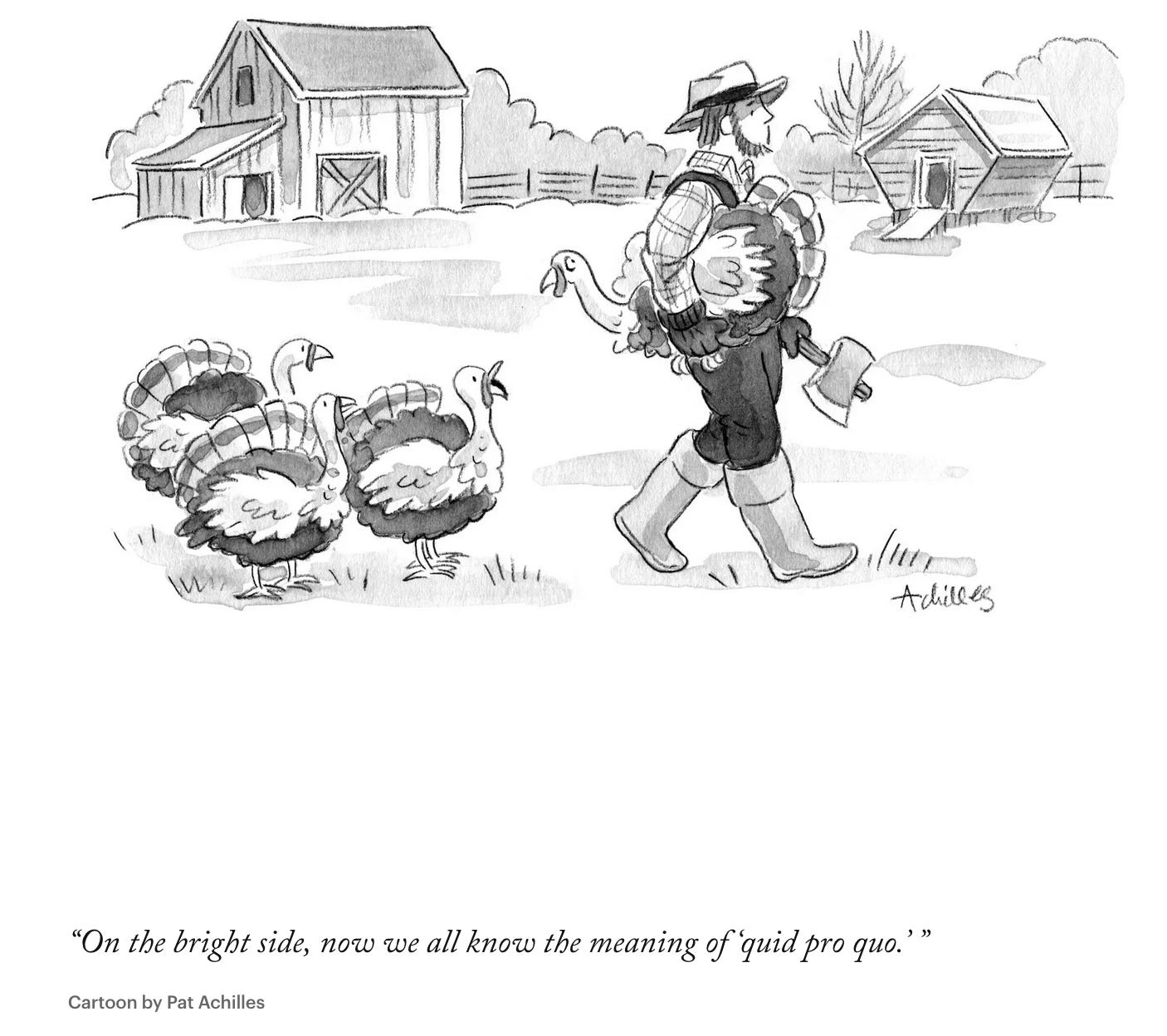
I believe this is called QUID PRO QUO - am I right - or not?

PS I wrote about the importance of safe capital requirements here.
The reason why central banks independence must be safeguarded in a functioning democracy and healthy economy is their core role is to safeguard the safety and stability of the financial system (and thereby protect citizens’ deposits and taxpayers money) - as well as honour their core mandate of inflation.
There’s a reason Trump is so desperate to get rid of Jerome Powell in the USA now, and take control of the Federal Reserve (central bank). The motivations are similar - cut interest rates, slash capital protections, undermine independence.
PPS The Treasury minutes also mention concerns about funding but in my opinion, it’s important to note the cadence and sequence which I believe would have resulted in Orr already feeling quite tense and set upon by the two senior authorities in the room (Willis and Quigley). i.e the capital review disagreement occurred first with Orr vs Willis/Quigley. And even after Orr left the meeting, Quigley once again appeared to support what Willis wanted regarding RBNZ’s funding - directly ignoring/undermining Orr.
I believe all these elements, combined with the performance management letter/actions of the Board, and the lack of trust between them, meant Orr’s position was now completely untenable and he saw no other choice but to resign.
Where Did Nicola Willis Receive Her Views About Capital Requirements From?


Take a guess, friends.
I’d wager NZ Initiative (“NZI”) - a key lobby group for the banks, with strong links to Atlas Network and other right wing ‘junk tanks’.
See below how Willis’s language in the meeting effectively mirrors NZI language and lobbying positions (not for the first time too - the latest is when Andrew Riddell pointed out the same situation in Willis’s recent “supermarket fast track” announcement)


As reported previously on this publication, even conservative commentators1 have spoken of Willis (and Luxon’s) reliance on the lobby tank -
“Finance Minister Willis is lost, with no answers to the nation's stagnation. It is why she has no plan. It is why she ran to Business NZ last week asking them what to do.
It is why she runs to the NZ Initiative asking them what to do….It is why they get no practical answers.”
And what happens if you speak up about NZ Initiative’s role in this government’s policy direction?
They write flattering, and if that doesn’t work, mocking letters to you - take a look at some of the examples here.
Conservative Robert MacCulloch’s Recent Reaction To Treasury’s OIA Letter:

In text form:
“This previously secret letter now exposed proves what we already knew to be true. Finance Minister Willis wanted the Capital Review done because the Big Banks had been lobbying her. Orr was strongly opposed, but was ambushed by a gang of two – Willis and Board Chair Quigley (who at the time needed Willis to approve his medical school). A nation cannot long endure with a crooked Finance Minister like Willis. Now she’s in cahoots with the Big Banks again to make the proposed consumer credit law bill retrospective to wipe the claims of their customers. Willis is the cause, not the fixer, of the cost of living crisis. Michael Reddells OIA letter proves she’s guilty – and up to her eyeballs in cahoots with the oligarchs – be they the banks, supermarkets or Fonterra.”
You don’t say.
Finally, Luxon has already admitted National has a pre-conceived outcome for the RBNZ’s Capital Review
Luxon - seen here laughing about knowing the pending capital review outcome in the first 20 seconds of this video:
Just as Chris Bishop’s $500,000 payment to Bill English ensured his pre-conceived outcome on state housing was attained, it appears the banks may have already won too.
National clearly have form on dirty politics and “quid pro quo”. Steve Joyce’s lobbying advice2 to Quigley didn’t work on Labour, but it sure as hell worked on the National Party.
An earlier version of this article misspelt a name - corrected 08:02
Spinoff: “Communications advice was provided by former National minister Steven Joyce, whose firm was paid nearly $1 million by the university over three years. According to documents released under the OIA, Joyce encouraged a shift from quiet lobbying to a public campaign that could, in his words, “shame” the then Labour government into supporting the project. Despite this, Labour never came on board – and now, as the school finally moves forward, questions remain not only about its cost and necessity, but also the integrity of the process that secured its approval.”
Nothing much to add to Tui's excellent post or comments today, but a couple of general observations:
The presumption that reducing bank capital requirements will make banks more willing to lend is misguided. Firstly, the banks may not see this as an opportunity to increase lending up to the amount predicated by the new capital requirement, rather they may just maintain the existing loans policy and transfer the excess capital assets outside of their LLC structure to their overseas parent companies. There is a precedent for this kind of erroneous presumption by the present government in the tax cuts made to private landlords. There was a presumption that the landlords would invest the tax saving in building new housing for rent; instead they took the money and invested it elsewhere.
Also we have to consider where the resistance to new lending is coming from. The government's presumption here is that it is coming from the banks' caution around placing their capital at risk. I would suggest that it is more likely coming from potential borrowers. In an economy where a person doesn't know if they will still have a job in a month's time, taking on a mortgage is a daunting prospect at any interest rate- especially looking at the predicament of their older brothers and sisters who bought at the peak in 2021. The presumption that a house is an investment is also wearing extremely thin.This recent Guardian article suggests NZ prices still have a long way to fall https://www.theguardian.com/world/2025/aug/29/new-zealand-house-prices-falling-could-this-happen-elsewhere Negative equity is not only a heartache for borrowers, for banks it means that their collateral is diminishing, which in turn means they will demand a prohibitively high mortgage deposit. Doubling up on a rental or moving into the parents' basement flat seems likely to continue as the favoured housing option.
A comment I received which I agree with and adding here:
Willis wanted to loosen the requirement for the banks to keep 18% of their risk-weighted assets as capital & Orr being adamant that would endanger the safety of the banking system.
This was the real reason Willis wanted to get rid of him. She squeezed him on funding for things he knew were important, like studying the effects the climate crisis would have on the economy - more catastrophic weather events, not only impacting infrastructure but food output, inflation & exports.