

OPINION AND ANALYSIS:
Chief Ombudsman Peter Boshier’s comments singling out Health NZ for “acting contrary to the law” couldn’t be clearer.
Health NZ has been acting as a law unto itself.
That includes putting its management under extraordinary Non-Disclosure Agreements within a public service.
Much more significant given health impacts every single Kiwi. Doctors’ and nurses’ warnings over the last year are coming to fruition -
Kiwis are dying - a tragedy linked to National’s healthcare intentionally underfunding Health to the lowest per capita level in a century while claiming “record investment” - and their freezing of hires and staffing.1
Health NZ management also blocked RNZ’s OIA requests on Dunedin hospital for months.
Boshier said the fines for officials breaching the Official Information Act (OIA) was “laughable” and recommended personal accountability of executives.
He singled Health NZ out in his critique.
Boshier:
"Health New Zealand is of particular concern. I regret to say that I have found on a number of occasions that it is not always following the letter and spirit of the law."
Regardless of political affiliation, OIA laws should be respected.
In another similar case last year, Housing and RMA Minister Chris Bishop also acted “unlawfully and unreasonably” by intentionally stymying OIA requests on Fast-Track.
The timeline of it is recorded below, but in essence, Bishop intentionally blocked the requests - until well after Fast-Track submissions had closed.
The DOC took the blame on paper, but communications show that DOC had urged Bishop’s office to allow them to release information - but were stopped from doing so.
Peter Boshier had also personally spoken to Chris Bishop to try to get him to comply.
Then this year, under continued pressure from the Ombudsman and a whole year after being asked, the National Government finally revealed a list of 97 Ministerial nominations for Fast-Track they previously claimed didn’t exist.
As summarised by Forest & Bird this meant:
“New Zealanders were denied any chance to stand up against the worst of these projects and stop them being added to the fast-track legislation”.
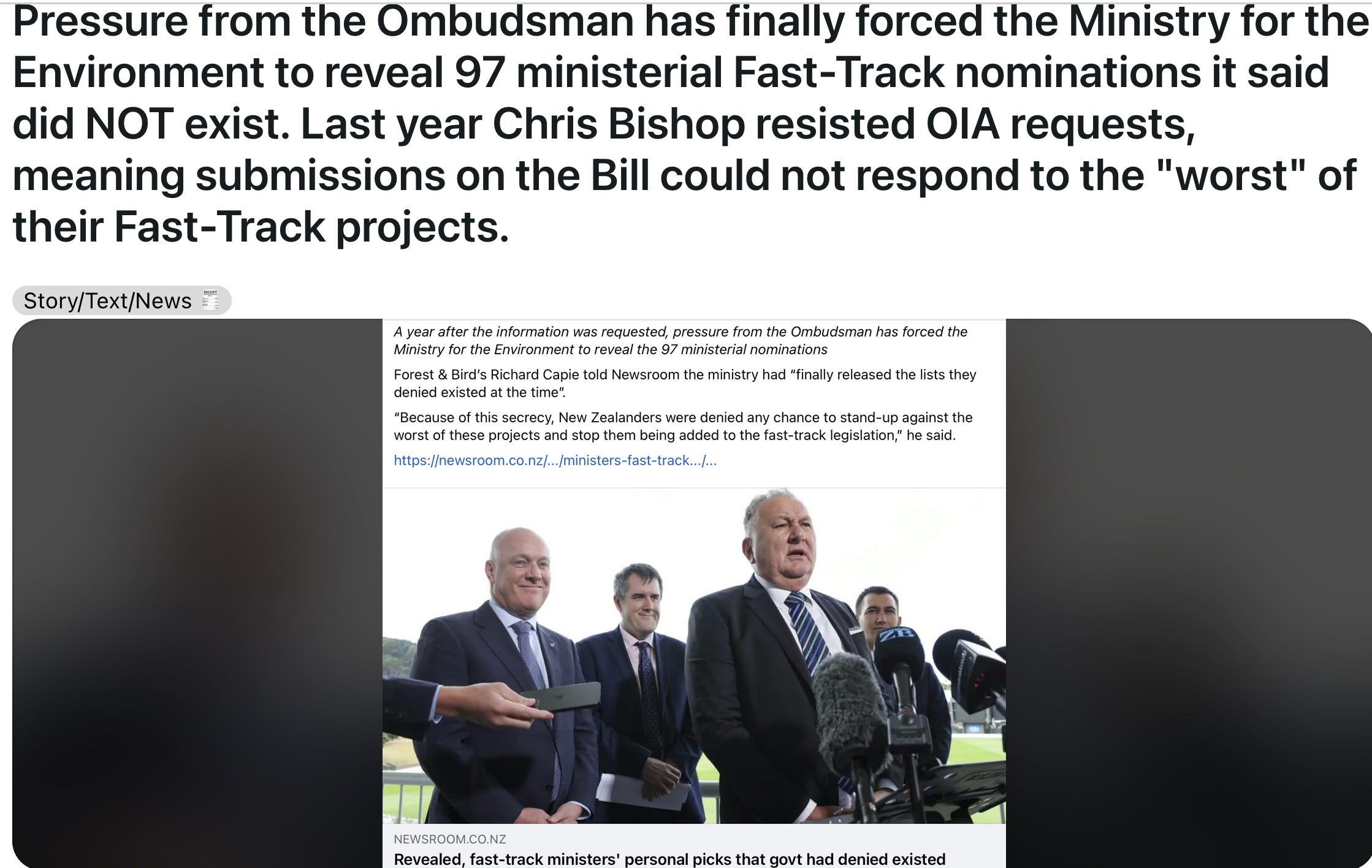
What’s even worse is when we consider that National and Chris Bishop intentionally broke Parliamentary laws to push the Fast-Track Bill through - despite being told it went against rules, and was improper to do so.
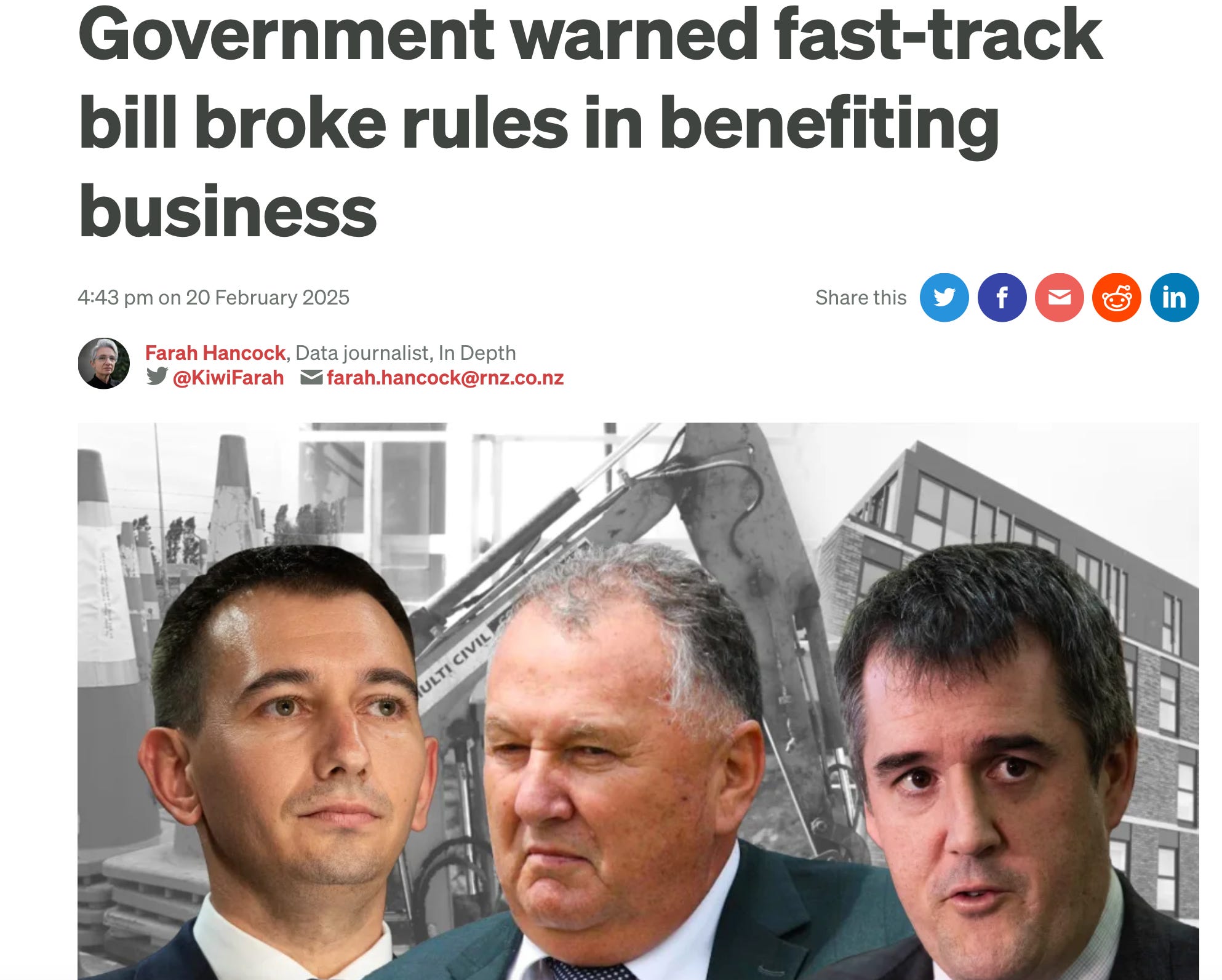
The government was warned that including private projects like mining and housing in the legislation would make it inadmissible as a government bill, as only private bills can benefit private entities.
…The Office of the Clerk - government's official rule-keeper - first warned Minister Chris Bishop about the potential breach in July last year.
… only private bills can benefit private entities.
The bill's amendment paper, which included the project list, was specifically designed to "fast-track" 149 projects … including many from private companies. These projects could skip a referral process and move straight to consideration by expert panels…
After Bishop did not respond to its initial concerns, the Clerk reiterated its advice in a long October letter…
On 3 October, Bishop text messaged Brownlee: "Can I talk to you re fast track?"
Ultimately, Brownlee was called into Parliament in December to override the Clerk and Deputy Speaker and help pass the Fast-Track legislation.
Last but not least, let’s not forget Casey Costello breaking OIA laws as she tried to keep information about her tobacco and vaping policy secret.
Incidentally, her policies seemed to keep benefiting Philip Morris, a global tobacco multinational and Chris Bishop’s former employer.
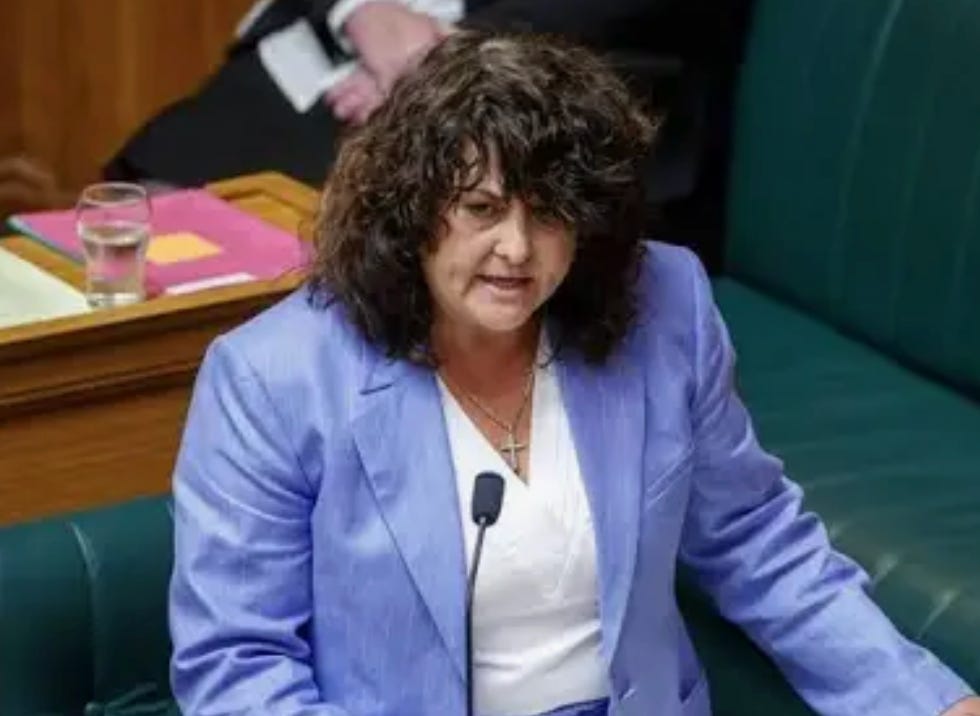
Boshier strongly reprimanded the NZ First Minister, former Taxpayers Union Chair, and Hobsons Pledge Trustee and Spokesperson for acting “contrary to the law” too.
What’s clear is the National Coalition have little respect for doing things the proper way, and transparently.
There is one thing Bishop is transparent about:
He boasted openly about being lobbied, saying, “there’s nothing wrong with lobbying…People want to use the law to get things done”.
Yes, laws National changed to benefit them.
The NZ Initiative (Formerly Business Roundtable) called the Ardern government one of the least transparent governments in NZ history.
David Farrar, a right wing mouthpiece who runs Curia Market Research and features heavily in Nicky Hager’s book ‘Dirty Politics’, pushed Andrea Vance’s article that Labour was one of the most thin skinned and least transparent governments she’d seen.
In theory, Stuff and The Post would have plenty to write about on transparency - especially when Kiwis are literally dying from the secrecy around Health and the stench of corruption around Fast-Track.
They would also be topics of great public interest and translate to clicks.
Instead, Tracy Watkins and her crew seem to devote substantive time and attention to Green Party criticism, frequently taking topics out of context, sometimes bordering on misrepresentation. For example, their article on Golriz Ghahraman which suggested she shoplifted again. She did not.
Corporate media is no longer reliable when it comes to public interest.
Neither is the National Party.
Related Videos:
Timeline: How RMA Minister Chris Bishop engineered a refusal of Forest & Bird’s OIA request on the fast-track bill, delaying its release until after public submissions closed.


March 08: Forest & Bird submit OIA to the Department of Conservation asking for the advice it had provided to Ministers regarding the Fast-track Approvals Bill
March 14: The Department of Conservation forwarded a list of documents likely to be included in the OIA to the Minister of Conservation's Office and noted that agencies were working to pull together a proactive release package. The Minister’s Office said it had seen an email stating the entire release package was going to be managed through Minister Bishop’s Office and would be released in roughly five weeks.
March 14 (continued): The Department expressed concern five weeks would mean the release ‘couldn’t inform submissions’ and said ‘we should be aiming for faster’. The Minister’s Office concurred and noted that it was awaiting an update from Minister Bishop’s Office about ‘when they’re aiming for but I just meant it will likely be less than 5 weeks’.
March 19: The Department of Conservation provides material for release to the Minister of Conservation. The Department was directed to participate in the broader Government proactive release. At this point, it was expected to occur approximately a week prior to select committee submissions closing. The Department noted as submissions to the Bill had opened, there was some urgency to provide key information.
March 20: The Minister of Conservation agreed to ‘the proactive release of all the attached briefings and memos as part of a wider package to be released by the Minister Responsible for RMA Reform’ subject to the proposed redactions. The Minister’s Office forwarded the Department’s papers to Minister Bishop’s office.
March 27: The Ministry for the Environment update agencies involved in the release. It says not all agencies had provided material for the proactive release and ‘at this stage’ it was aiming to get a full package . It notes: The timing after that depends on the Minister’s Office and will likely be a week at least.
April 03: Department of Conservation staff note the timing of the proactive release did not sit well with its responsibilities under the OIA.
April 08: Department of Conservation refuse Forest & Bird's request on the basis the information is going to be made publicly available soon and will be released by the Office of Chris Bishop, Minster responsible for RMA Reform.
April 11: The Department of Conservation note following a conversation with the Minister of Conservation's office it was not hopeful the release would occur before submissions closed but that the Ministers office 'would prefer we didn’t release the documents separately to the proactive release process’
April 19: Submissions to the Fast-track Approvals Bill close
April 24: The Department of Conservation emails Forest & Bird apologising for the delay.
May 27: Information published online
June 11: The Office of the Ombudsman finds the refusal to release the information was unlawful and unreasonable.
Related Articles (Media)
Fast Track
How the Fast-track Approvals Bill became law (RNZ)
Government warned fast-track bill broke rules in benefiting business (RNZ)
Revealed, fast-track ministers’ personal picks that govt had denied existed (Newsroom)
Ombudsman Spoke Personally To Chris Bishop
Fast-track legislation: DOC's OIA refusal was unlawful - Ombudsman (RNZ)
Health NZ
Boshier criticises Health NZ Te Whatu Ora OIA policy (RNZ)
Te Whatu Ora racks most complaints for OIA request delays, refusals (RNZ)
Ombudsman raps Waikato Hospital over tardy response
Casey Costello - Tobacco
NZ First Minister Casey Costello forced to apologise after acting ‘contrary to law’ (RNZ)
The tobacco industry language that found its way into ministerial papers (RNZ)
Related Articles (Mountain Tui)

Their answer to Nelson doctors blowing the whistle is to consider more privatisation, which will break down our public system more.
Sometimes I can hardly tell if I’m reading about the USA or about Aotearoa, the lies, the corruption and riding roughshod over laws and conventions are so similar.
Excellent summary MT! I also wonder about the cynicism to push through FastTrack legislation was a simple device to co-opt all members of the government to vote for this bill. The convention in NZ is that members of the government are generally bound by the principle of collective responsibility, which requires them to vote as a bloc on government bills. This ensures unity and accountability within the executive branch. However, for private members’ bills, MPs, including government members, are often allowed a conscience vote (a free vote), where they can vote according to their personal beliefs rather than party lines.
Whether any of the current MP’s would have had the courage to stand against this clear breach of convention and breach of Parliamentary rules is another matter.
Speaker Brownlee has a lot to answer for as well in allowing this through.
(Of course this government is unlikely to follow any convention that doesn’t support what they want to do anyway 🙄)
It’s also of interest that Minister of Conservation in March (and is still) was Tama Potaka. Looks like he got bulldozed again by the Rat Pack in the cabinet.
So it’s a bit of a nasty little triangle isn’t it: Ministers prepared to break the rules of parliament to push private interests; Ministers prepared to breach Official Information Act to hide what they are doing (or as a minimum delay until the information has no effective power); and a Speaker prepared to rule in whatsoever manner reversing previous consensus and rulings to accommodate them.