

The Mayor of Whanganui is an “organisational change specialist particularly in the area of workplace culture.” According to his LinkedIn profile, “Andrew is often heard saying Culture executes strategy!”
Tripe’s resume reads as a respectable sheet: management consulting, big banks, public sector. He holds pre-and post university qualifications.
A proud fourth generation Whanganui resident, and married for over 20 years with a fulsome, Christian family, Tripe lists his interests as “exercising, playing chess, share trading, as well as family time.”
In other words, Mayor Tripe appears, for the most part, as an everyday good guy and Kiwi.
But what raised eyebrows over the last weeks was Tripe attending and speaking at a local Whanganui vigil for slain right wing activist Charlie Kirk.
No violence is acceptable and condolences go to Kirk’s family and loved ones, without doubt, but it was interesting to see a locally elected New Zealand Mayor attend a formal vigil. And see how much Kirk touched him personally.
At the vigil, Tripe described how he was“devastated” at Kirk’s death, how that led him to lose hope for a while, “A hope in someone who’s going to give us the truth”, because “Charlie shed his blood for us”. His speech appeared to be littered with references to Christianity - calling for a “revival” speaking of faith and hope, and “it is our call to act on what Charlie was doing, boldly”
There were various other vigils around New Zealand too, some organised by Churches - the one in Whanganui, Orewa in Auckland, Invercagill etc.
What’s clear though is how, slowly but surely, elements of US culture and politics have permeated very successfully into the nation - aided by media of course e.g. Stuff live streamed Charlie Kirk’s funeral, 1News led with it as their top story, NZME hosted headlines providing positive associations with Kirk etc.
It’s inevitable that these touch points extend their reach successfully.
And US politics & Trump Republican ideals are making its way into our political and leadership circles everywhere - from boardrooms to governments to certain Churches to respected families and community members.
Tripe’s devastation and reaction appears to have been borne from a much longer association with Charlie Kirk’s words and ways. And although Tripe distanced himself yesterday, claiming he didn’t really know much about Kirk and had only attended the vigil “naively”, he didn’t appear that way on the video - to my personal interpretation.
When I first started writing on Substack, ~15 months ago now, I put together a piece where I was trying to put into words what I had come to intuit about politics and the various players within it. (yes, everything was new to me)
And I’ve still found no better analogy

Cells permeate and influence other cells. Inevitably some morph and become a replica.
Some of the initial ones were planter cells - there to spread a certain message - but it can and does spread. The mass reach of social media and certain “media networks” then take the reach farther. It’s perhaps a matter of evolution that the States and the UK are farther along that path than we here.
And my perception is that culture begets culture, belief begets belief, extremism spreads extremism, and as the Mayor of Whanganui said: “Culture executes strategy”
If Tripe had not been so moved by Kirk’s death, would he have spoken those words so easily?
Ultimately, I don’t know the depth of another - but I would rather see the evolution in NZ come out from behind the curtain, and accept how far reaching US politics and its catch calls of “freedom”, “free speech,” “liberation,” etc have become - even in people we may not have suspected it to touch.
Ignorance is no defence to this evolution. Awareness and information can inform and defend better than ignorance.
Winston Peters wrote the Palestine Cabinet paper
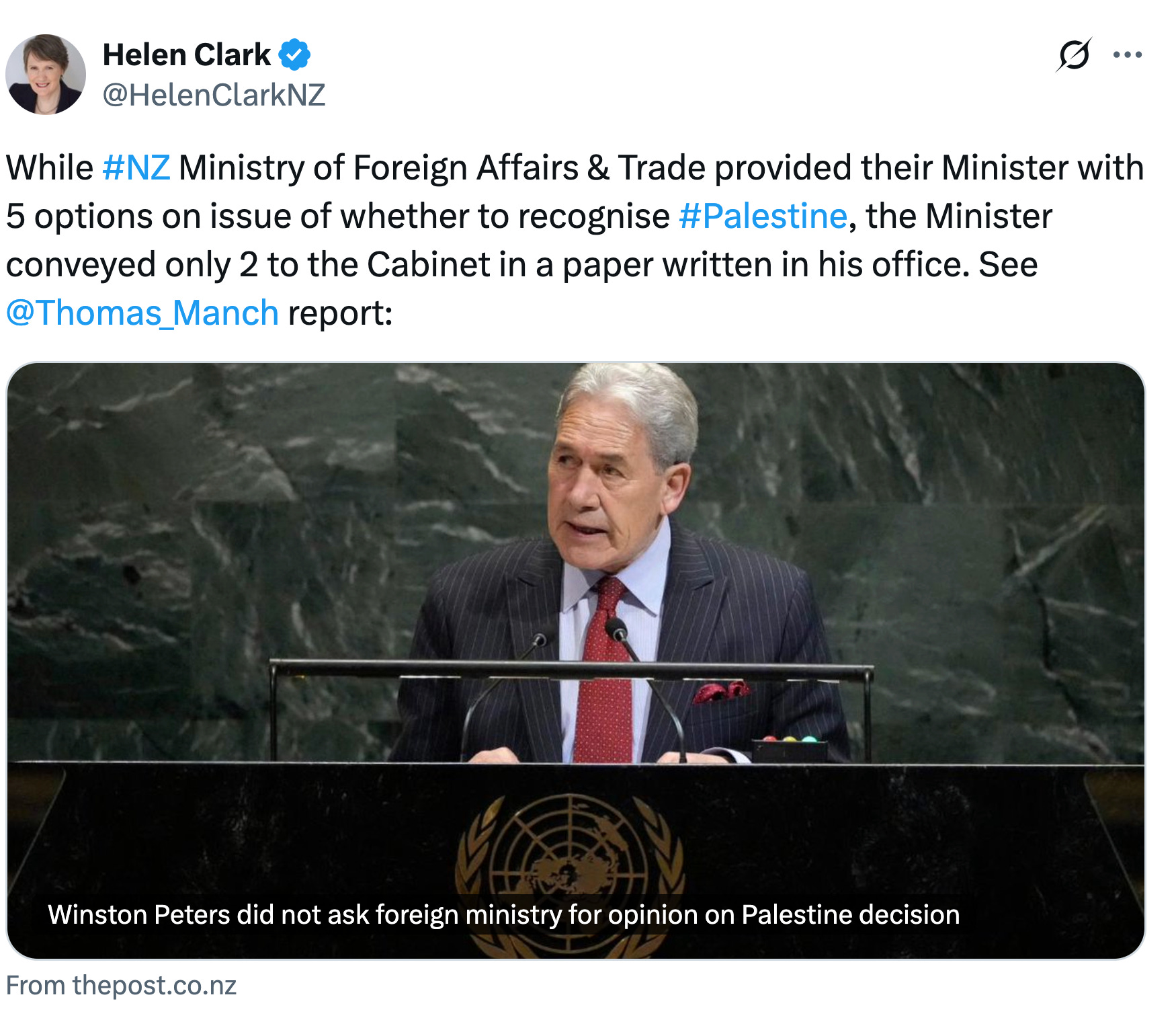
“While the [Palestine statehood] decision, made by Cabinet earlier this month and announced by Peters at the United Nations on Saturday, was informed by advice provided by the Ministry of Foreign Affairs and Trade (MFAT), Peters’ own staff wrote the crucial Cabinet paper which [kept] two [of five MFAT] options.
Typically, Cabinet papers are prepared by a government department, in consultation with the minister and their office, and submitted to Cabinet for consideration under the minister’s name.
In the case of the decision not to recognise Palestine, however, staff in Peters’ office took charge of writing the Cabinet paper…
[The 3 removed] options included: conditional recognition on the basis the Palestinian Authority make a tangible commitment to progress, as Canada had done; use recognition as “leverage” by threatening to recognise unless Israel met certain conditions, as the UK did; or, commit to recognition in September without preconditions, as France had.
Foreign Minister Winston Peters [also] did not ask the foreign ministry for an opinion on the Government’s controversial decision to not recognise Palestine as a state.”
Source: The Post
This puts to bed the idea that the Palestine statehood decision was driven solely by ACT, and that it was more a genuine three way agreement between the Coalition government leaders.


