

OPINION/ANALYSIS:
Part 2 of this article is found here
As news hit tonight that RBNZ Chair Neil Quigley resigned with “immediate effect” a few minutes before the 6pm news bulletins, more information is starting to drip out as to why.
In short, Quigley, a National Party loyalist with links to ACT Party regulation, lied to the public about Adrian Orr’s departure from the RBNZ.
And persisted in trying to cover it up to the very end.
Adrian Orr was clearly pushed out and put under significant pressure from Quigley and the RBNZ Board before he “resigned”.
Conservative commentator Michael Reddell writes of this event:
“We have been misled and obstructed, deliberately, from day one – by someone who reveals repeatedly a disdain for public scrutiny and accountability, let alone the law when it might inconvenience him. Almost singlehandedly (although don’t forget Hawkesby and the rest of the Board)..”
Nicola Willis knew too - more on that later.
Importantly, there was also a significant trail of evidence that the RBNZ undertook a concerted efforts to thwart OIA requests about Orr’s departure.
This is one example -
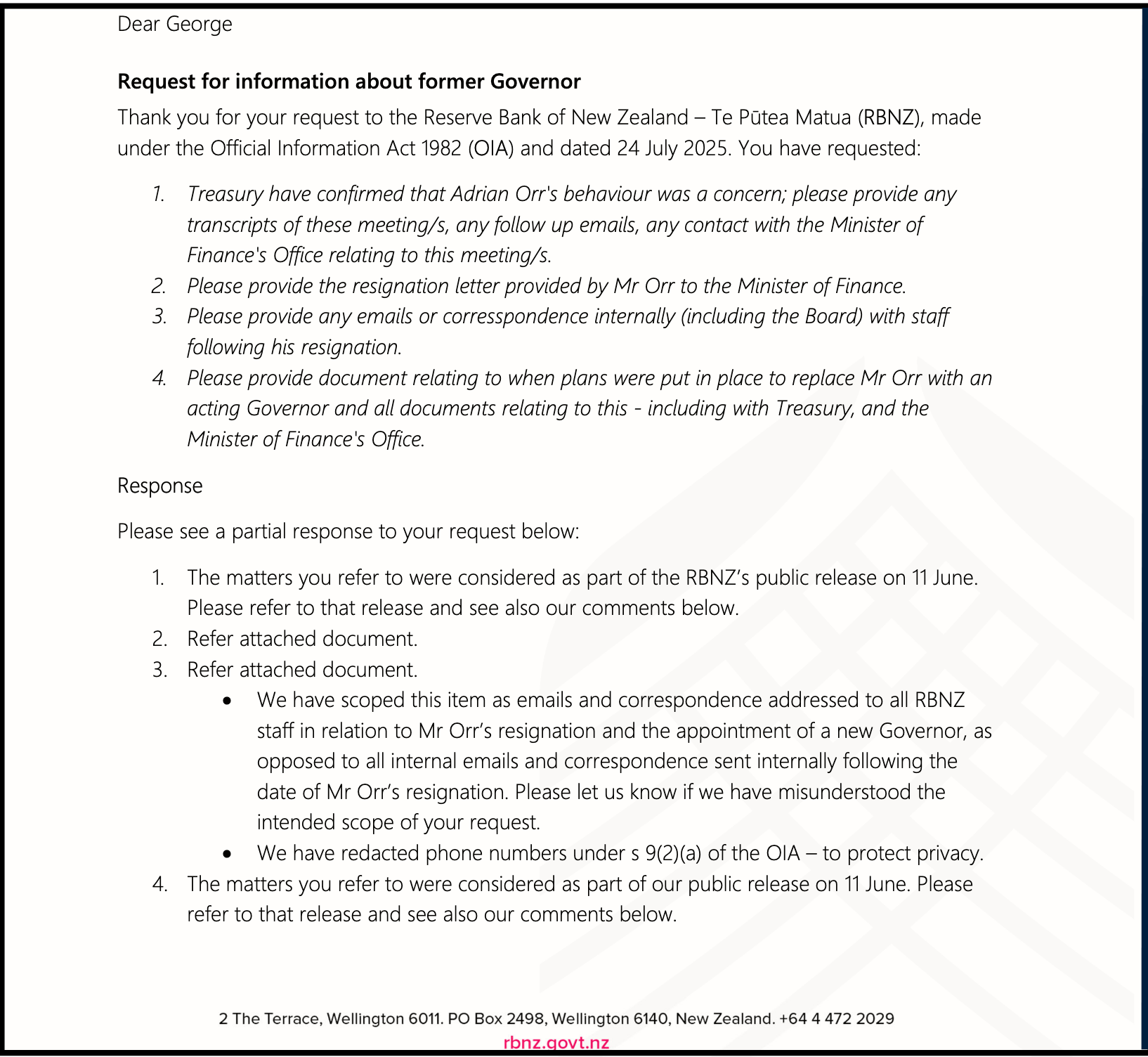
It was not until the Ombusdman ordered RBNZ to release all documents yesterday, that Quigley finally accepted the writing on the wall.
Hence “resignation with immediate effect”.
Remember this all comes against the backdrop of Quigley telling New Zealand Orr left of his own volition:
“It was a personal decision,” we were led to believe from official statements on March 5.
And Nicola Willis concurred - standing by the RBNZ over all these months.
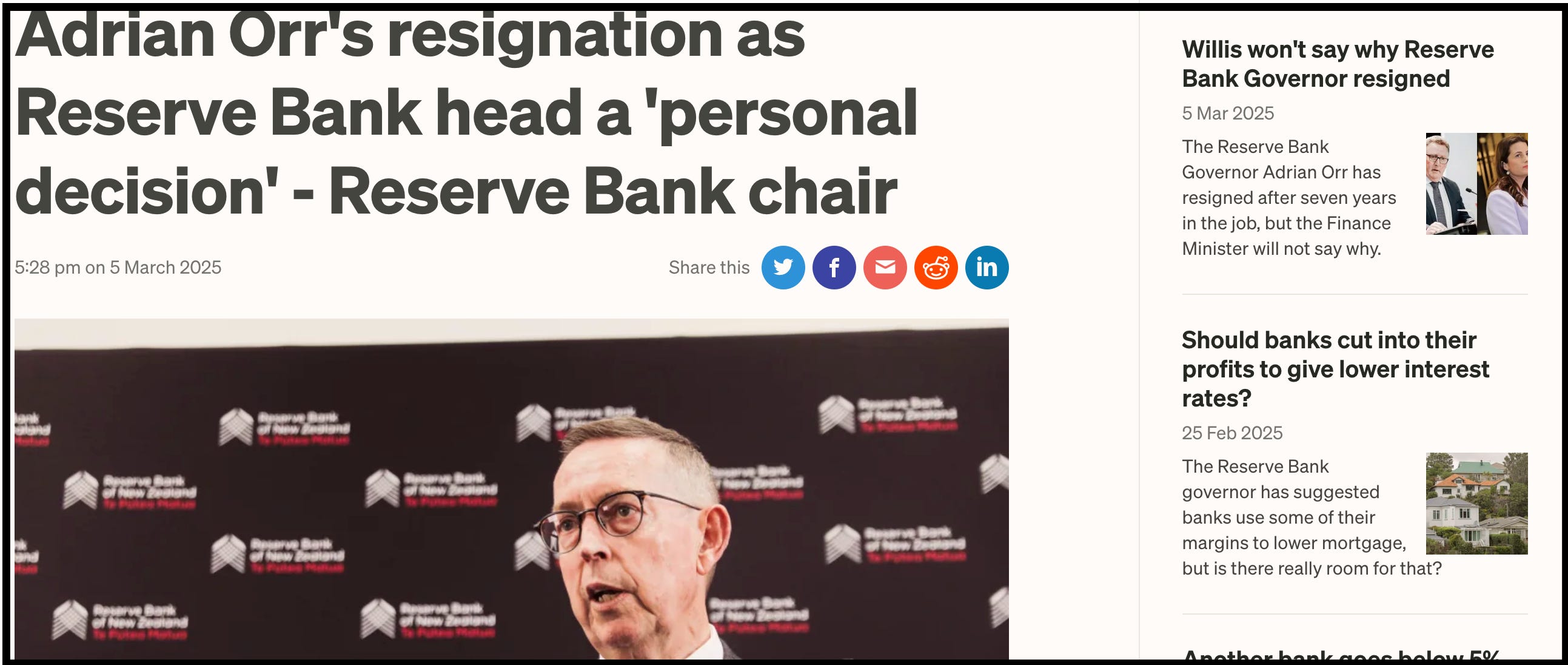
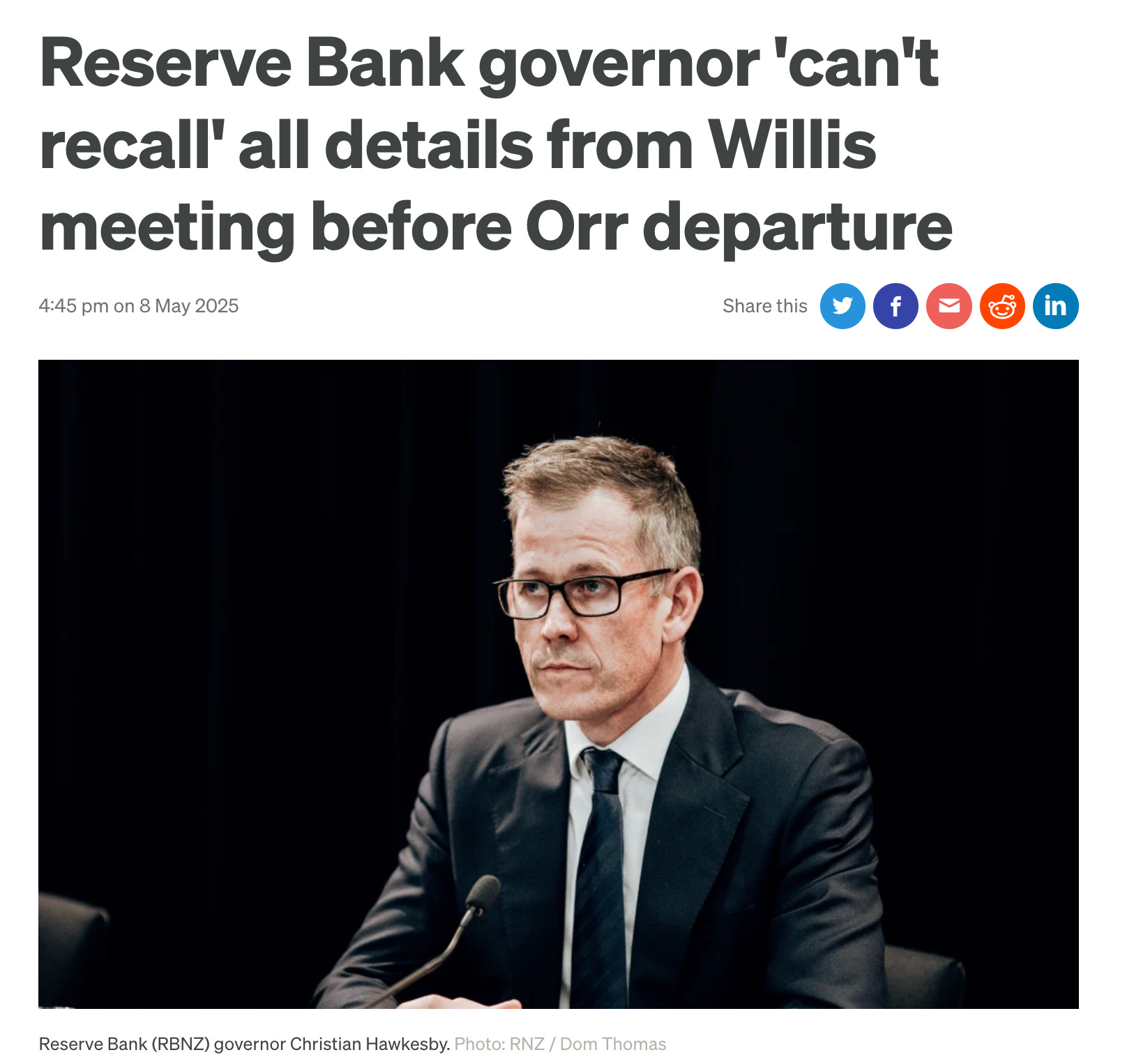
Well it turns out Orr left the RBNZ a week earlier on February 27, when Hawkesby assumed temporary responsibilities, and Quigley, writing for the Board, sent Adrian a “statement of concerns” - which is a performance management document that can be used to exit executives in due course.
The Herald’s Jenée Tibshraeny reports this came as “tensions between him, the board, Treasury and Finance Minister Nicola Willis over government funding reached boiling point.”
Orr responded to the letter two days later, rejecting the Board’s assertions, but agreed that there was a “lack of trust” between himself and the Board. Days later, he agreed to resign.
A Pattern of Lies
When pressed about Orr’s departure in June 2025, Quigley had claimed Orr was unhappy with the reduced funding envelope from Treasury. The Central Bank then released a series of documents supporting this view.
On June 11, The Post’s political editor, and former NZ Initiative fellow Luke Malpass write an article about Orr based on that information, saying:
“Adrian Orr thought the bank needed more money. His board disagreed, the Minister of Finance disagreed, he found the process distressing and he resigned….
Giving the impression that it was for some undisclosed personal reasons - as the bank has done for three months now which no one really believed, and which the bank confirmed on Wednesday was not really the case - covers no one in glory and leaves an important national institution just a little poorer.”
Again - even that story was a partial lie. And again Nicola Willis knew.
A deliberate, calculated lie to the New Zealand people, compounded by a persistent, pervasive cover up from Quigley and co.
Quigley to Shane Reti in 2023. “The first student intake for the Waikato Medical School would be 2027 – a present to you to start your second term in government!”
Dishonest to the end
Reddell’s persistence in trying to shed light on Orr’s departure is commendable. And it saw him have better luck on the Treasury side.
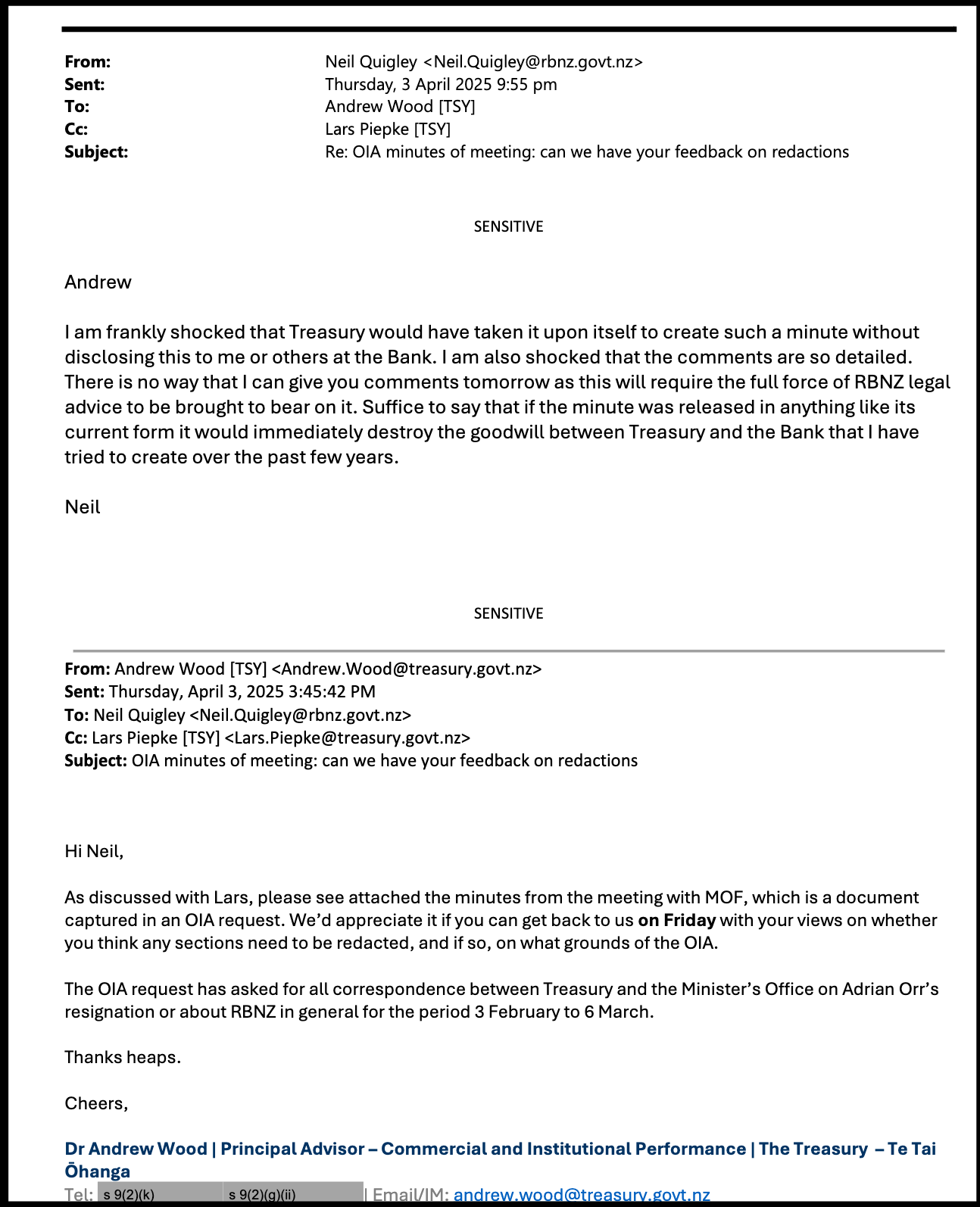
Treasury officials had minuted the explosive meeting between Willis, Orr, Quigley etc. that preceded Orr’s “statement of expectations”.
Once Quigley realised this, the Chair of NZ’s central bank, wrote an extraordinary email back, with a threat, and clear signal that Quigley thought he was above public scrutiny -
“I am .. shocked that the comments are so detailed…Suffice to say that if the minutes were released in anything like its current form it would immediately destroy the goodwill between Treasury and the RBNZ…” - Neil Quigley on an OIA request
Nicola Willis knew too
Tibshraeny reports on whether Nicola Willis was transparent enough:
Pushed on whether she herself had been transparent through the ordeal, Willis said she reiterated on several occasions that the bank should have been more open.
She conceded she knew Orr stepped back from the role before he resigned, and knew the board gave Orr a letter with its concerns…
Willis never responded to questions the Herald emailed her on Thursday night, asking if she still had confidence in Quigley, whether she had been complicit in what looked like a cover-up, and how the public could have confidence in Quigley’s judgement when it came to the appointment of a new Governor.
i.e Nicola Willis knew - and the Finance Minister should resign for this explosive and pervasive act of deception on the people of New Zealand.
The next week will be telling.
“Who is Neil Quigley?”
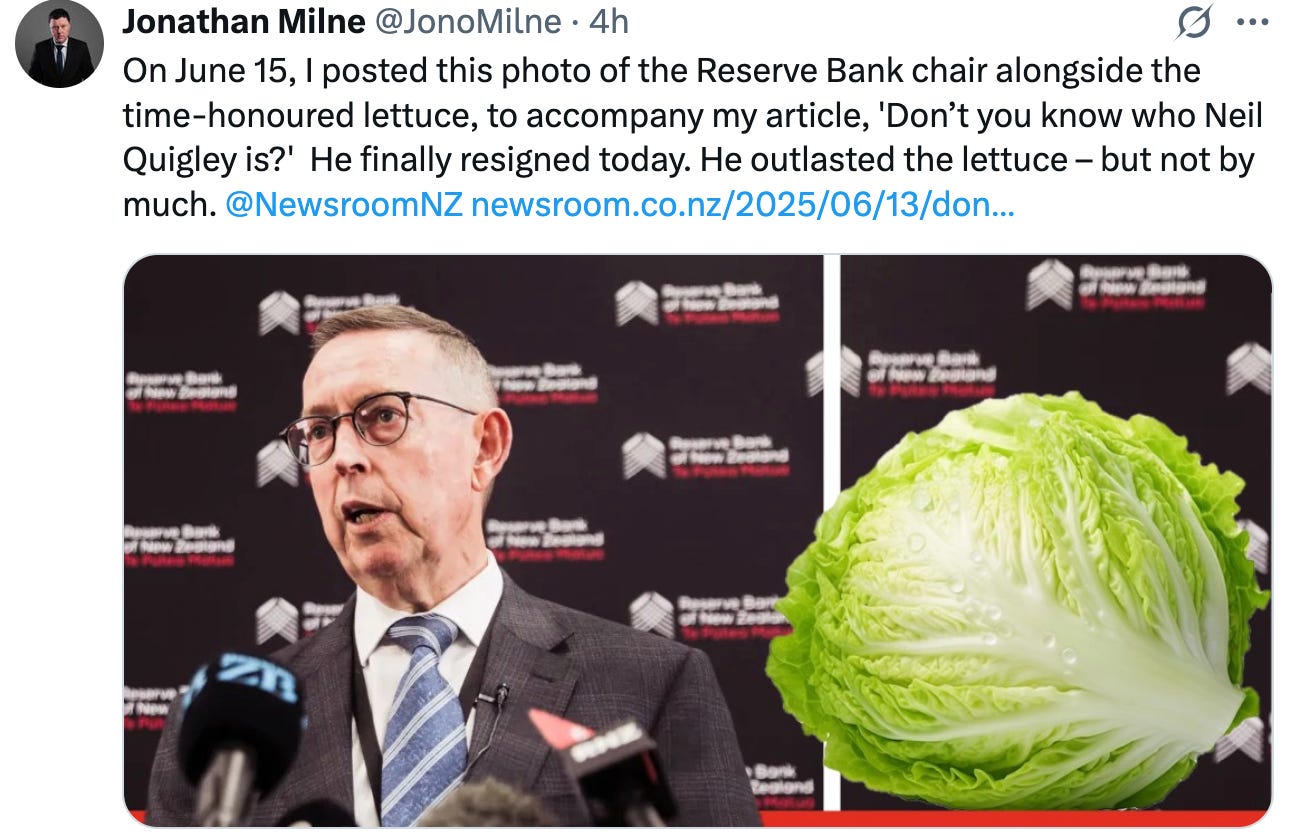
For those who are interested in Quigley’s background, Jonathan Milne recounted it below.
“According to several of those who’ve worked with him most closely, [Quigley] regards himself as a sophisticated political player. But in their opinion, he can be clumsy and lacking in self awareness…
Described as an economist of international standing, with a long track record of academic and strategic leadership, Quigley has been a member of boards and expert advisory groups; he’s been Deputy Vice-Chancellor of Victoria University of Wellington, and is now Vice-Chancellor of the University of Waikato.
In 2009, he was invited to join the expert team advising the members of the John Key Government’s 2025 Taskforce. The taskforce, part of a coalition deal with the Act Party, was charged with recommending strategies to close the income gap between New Zealand and Australia by 2025. (With the benefit of 2025 hindsight, that didn’t go well.)
He worked alongside another economist, Michael Reddell. Reddell penned the taskforce’s first report; Quigley penned the second which commended, among other things, the Act Party’s Regulatory Responsibility Bill – only now making its way through Parliament, 15 years later….
The person who claims to have recommended his appointment to the Reserve Bank board was Reddell, then a Treasury special advisor who subsequently became a Quigley colleague and confidante – and ultimately his most trenchant critic….
Quigley was becoming close to the National Government establishment…
[In] 2023 [Quigley was involved in] “Giftgate” – the revelation of Quigley’s cosy relationship with the opposition National Party to help it draw up an election campaign policy to establish the country’s third medical school, at his university.
Documents showed Quigley drove the policy, and was in constant contact with the party’s health spokesperson. Shane Reti sought information and advice from him on multiple occasions, including asking him how quickly a medical school could be up and running.
“The first student intake would be 2027 – a present to you to start your second term in government!” Quigley wrote. This was, of course, before National has been elected to a first term.
This sparked concern from voices on both sides of politics, that Quigley lacked the requisite independence to continue in his other role as Reserve Bank chair…
At the same time as the Giftgate controversy, in his other job in Wellington the Reserve Bank was facing criticism for allegedly “blackballing” active research economists from membership of the monetary policy committee, which sets interest rates.”
Marc Daalder also wrote about Quigley’s extensive conflicts of interests for the National Party two years ago too.
Updated: 12:10am August 30, 2025
A note:
Reducing the capital requirements, as Willis wants and as Orr resisted, merely increases the risk banks take on - and at our infinite expense as it is taxpayers who bear the real brunt of high risk banking activity. And it practically serves to increase banking profits.
Orr would have stood in the way of capital requirements being cut - and that's why he had to go. Sending him a performance management level put enough pressure on him that he jumped - to all of our detriment. Then they covered that up
Well done The Ombudsman!
My complaint to the Ombudsman about the PROCEDURE in a Doctoral Examination at Victoria University under Deputy Vice-Chancellor Quigley's management - in December 2012 - was unsuccessful. It was blocked by Professor Quigley on the grounds that the Ombudsman could not change the result of an examination in a University. My complaint was about the PROCEDURE that resulted -- in what I considered --s the only expert examiner -- as a Fail that resulted in a Pass. The decision on the Pass was made -- as if settling a dispute between examiners -- by an openly biased Referee -- who stated to the meeting he was a friend of an academic who was the husband of a Dealer with financial interest in the result of the Examination -- & that he had not read the Thesis - only the Examiners' reports. There was in fact no DISPUTE between examiners, simply a difference of opinion on the Result after reading the thesis - 2 For & 1 Against - & no Examiners Meeting permitted by the Supervisor of the Exam -- & my attempt to have a conversation -- after the reports had been filed with one of the examiners was foiled because the normal Rule about no discussion during reading -- was supposedly extended in the case until the Oral Exam -- & therefore no agreement or disagreement about what the examiners needed to ask in the Oral -- The candidate used the Doctorate to get a good job in a Public Art Gallery - & I -- as an examiner abused by the candidate as an "elitist" & a" university trained intellectual" in the thesis -- was never invited to examine again. The candidate's father who asked to be present at the Oral Examination -- was a Deputy Vice-Chancellor at another University.